



From the moment a discovery is made in the lab until it reaches people’s lives—this journey involves the challenge of exploring possibilities yet to be seen. In the series “Where Innovation Is Born,” we trace the paths of the people who have nurtured Kirin’s research and technology, examining the “next steps” they have tackled and the innovations they have created.
The focus of this installment is Kenta Jonai, one of the researchers who discovered the immune-modulating functions of “L. lactis Plasma” (plasma lactic acid bacteria).
Having overcome numerous obstacles and setbacks, Mr. Jonai is now moving forward with the challenge of applying L. lactis Plasma to pharmaceuticals. What is the “Next Kirin” that lies at the end of his passion—a passion fueled by his fascination with the unknown and his unwavering belief in possibility?
Pursuing What’s “Interesting”: Taking the Potential of “L. lactis Plasma” to the Next Level
- Pioneer with Innovation
- Research on Kirin
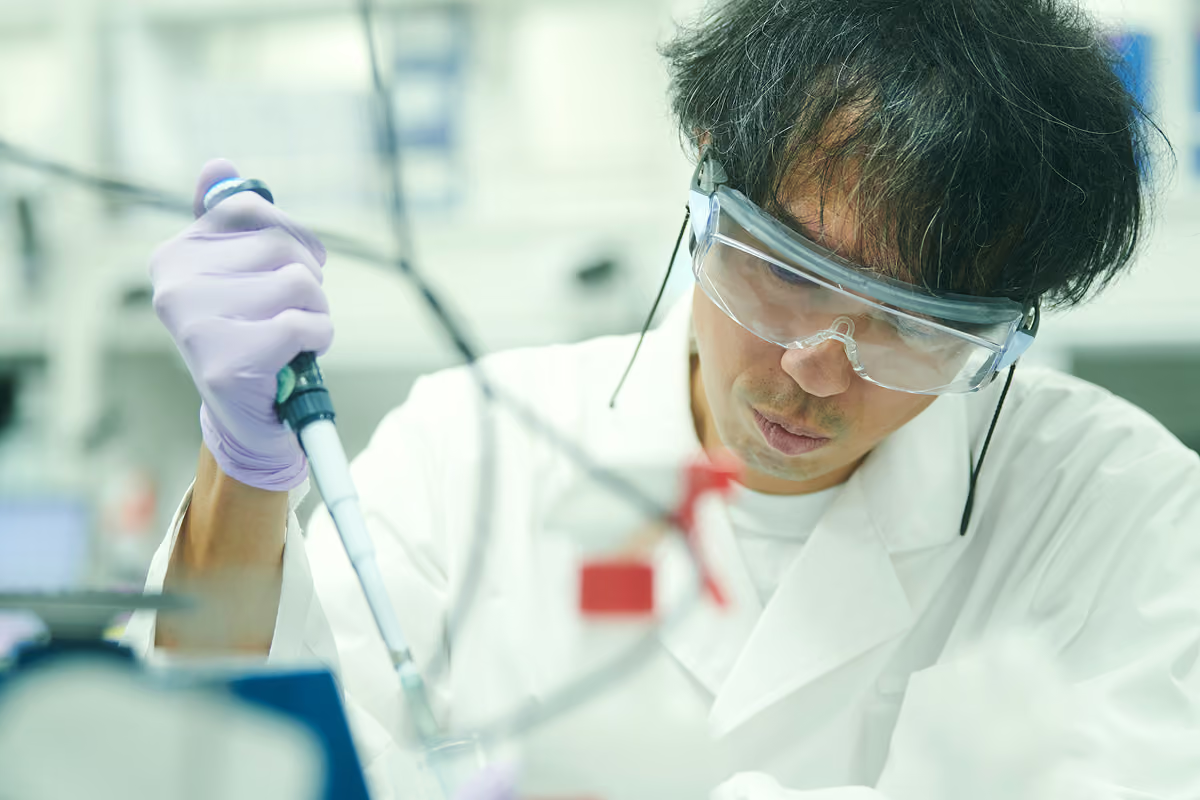

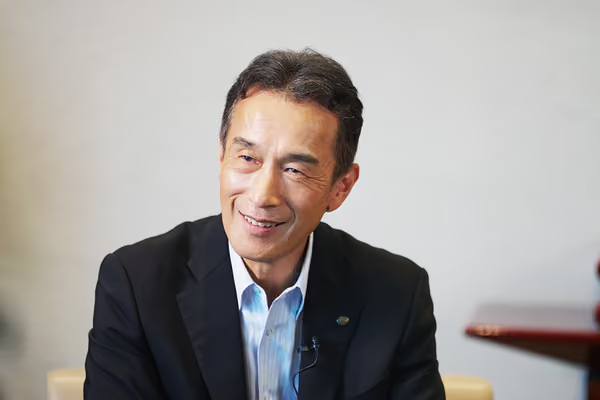
Kenta Jonai
Senior Researcher, Institute of Health Sciences, Health Science Business Division, Kirin Holdings.
He joined Koiwai Dairy in 2007 and worked in the Quality Control Department before being sent on a long-term assignment to the Kirin Holdings Frontier Technology Research Institute in 2008. From 2015, he worked as a research fellow at the National Center for Geriatrics and Gerontology. He subsequently took charge of marketing at Koiwai Dairy Product and was seconded to the Kirin Central Research Institute (now the Institute of Health Sciences) of Kirin Holdings Company, Limited. in 2021. He also serves as a collaborative researcher at the National Institute of Infectious Diseases.
A top-tier journal flatly rejected it. Yet, he continued to doubt—and what lay at the end of that research?

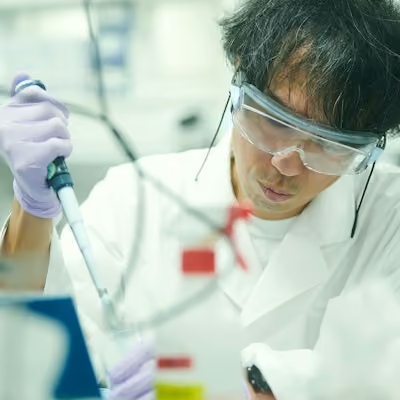
I came to Kirin’s research institute from Koiwai Dairy in 2008, essentially on a secondment. After working on a different research topic for about a year, I was assigned to research a lactic acid bacterium that activates a certain type of immune cell. That became what would later be known as “L. lactis Plasma (Plasma Lactic Acid Bacteria).”
L. lactis Plasma acts on immune cells called “plasma-like dendritic cells” (hereinafter referred to as pDCs). There are various types of immune cells, but pDCs play a crucial role and are often referred to as the “command center of the immune system.” To use a corporate analogy, pDCs are the “CEO,” and the other immune cells are the “staff.” When the CEO issues a clear command, the staff spring into action all at once to protect the body. That’s the basic idea.

The reason lactic acid bacteria can activate immune cells in the first place is that the sensors on the immune cells detect components contained in the bacteria and receive a signal to “get moving!” Therefore, if we could find a strain of lactic acid bacteria capable of directly motivating the CEO—the pDC—we might be able to activate the entire team of subordinate immune cells. This was the truly fascinating part.
However, at the time, a paper stating that “lactic acid bacteria cannot activate pDCs” had been published in a top-tier academic journal. The prevailing theory was that “lactic acid bacteria just can’t do it,” and at first, I believed it too, thinking, “Well, I guess that makes sense.”
But when I read the paper more closely, I realized they hadn’t thoroughly investigated every single strain of lactic acid bacteria in the world. “If that’s the case,” I thought, “maybe the one we’re looking for is among the strains we haven’t tried yet.” So, I decided not to give up and started searching.

For the experiments, we adapted verification methods originally used in pharmaceutical development. That said, we didn’t have a stock of every single lactic acid bacterium. It was a repetitive, painstaking process: ordering numerous strains from public lactic acid bacterium banks, culturing them one by one ourselves, and applying them to cells to observe the reactions…
Whenever experimental data came in, the whole team would gather and ask, “What does this mean?” “What do you think is actually happening inside the cells?” We’d lose track of time as we debated. It was just so much fun. The unknown phenomena unfolding right before our eyes were simply fascinating, and we’d huddle together, completely absorbed in our thoughts.
It was during those days that we discovered a new function possessed by L. lactis Plasma. I believe that by questioning established theories, we were able to open a new door in science.
Would the results hold true outside the test tube…? The barrier left behind by a shelved study

We had determined that L. lactis Plasma activated pDCs in a test tube. But that wasn’t the end of it. To be honest, I was a bit apprehensive about the next steps. That’s because, in a research project I’d worked on previously, we’d also achieved excellent results in the test tube. However, during subsequent verification, we didn’t get the results we’d hoped for, and ultimately, that research project itself was shelved.
Because of that bitter experience, even as I was planning this research, I felt a gnawing anxiety in my stomach, wondering, “Will this really work…?” I wasn’t at all brimming with confidence from the start, thinking, “We’ve got this!”
Still, I proceeded with the research while carefully refining the conditions. As I repeatedly verified the results and conducted follow-up tests, I was finally able to obtain results that convinced those around me. “Maybe we can move this research forward. Oh, I’m so relieved,” I thought, finally feeling a deep sense of relief from the bottom of my heart. For me, it was also the moment I overcame a major obstacle I’d faced before, so it was especially gratifying.

However, at that point, the reaction within the company wasn’t as strong as I’d expected. From their perspective, I suppose they were thinking, “We understand that pDCs are activated. But what value does that ultimately have for us?”
So, I delved deeper into the research to answer the question, “So, how exactly does this contribute to protecting health?” After conducting extensive verification from various angles, I was able to obtain clear data supporting the effects of L. lactis Plasma.
When I reported those results, the office began to buzz with excitement— “This is absolutely amazing!”—and the atmosphere changed completely. I still vividly remember that moment when a single piece of data, with its persuasive power, completely transformed the mood around me.
In this way, as we built up solid evidence piece by piece, research on L. lactis Plasma began in earnest, moving toward the realization of new value that contributes to health.
The pain of seeing products left on the shelves. Children’s smiles changed the meaning of our research
In 2012, Koiwai Dairy finally launched a drinkable yogurt made with L. lactis Plasma.
However, sales didn’t meet our expectations. That was really tough. It made me realize that reality isn’t so forgiving, and I also felt guilty, worried that I might be causing trouble for Koiwai Dairy.

I really love Koiwai Dairy. I grew up in my hometown of Iwate and used to visit Koiwai Farm often since I was little, so I was thrilled just to be hired there. The employees are warm and friendly, and it’s the kind of company where the president will casually strike up a conversation with you. That’s exactly why I couldn’t just stand by and watch the products of a company I love so much fail to sell.
So, drawing inspiration from a case study where local children were given lactic acid bacteria products to drink and their subsequent health changes were monitored, I wondered if we could do something similar with L. lactis Plasma. I consulted with the marketing department and the Morioka branch of the sales department, expressing my desire to conduct the project in Shizukuishi Town, Iwate Prefecture—where our factory is located—and we also secured the cooperation of Iwate Medical University for the verification process.
Since the program targeted children, we faced some challenges, such as rigorous questioning during the ethics review regarding safety and emergency response protocols.
Nevertheless, thanks to the understanding and cooperation of everyone involved, we were able to distribute yogurt containing L. lactis Plasma three times a week for about two months to elementary and junior high school students in Shizukuishi Town.
When I saw photos of the children in Shizukuishi Town enjoying the yogurt, I thought, “Ah, I’m really glad I pursued this research.” I was also incredibly happy to receive words of gratitude from the schools and the Board of Education.
To be honest, as for whether this initiative became a major talking point and led to an immediate surge in sales—it didn’t quite work out that way. But there was a significant shift in my own mindset. Up until then, the only thing that mattered to me was being able to enjoy my research. But I realized for the first time that this is what it means when your research brings joy to someone else. That was the moment my perspective changed.
Research is incredibly fascinating. Still, I want to focus on “making a product that sells”
I’m talking about “challenge” as the theme this time, but I also get the feeling it might not be such a big deal after all… Honestly, I was just completely absorbed in what was right in front of me.

We’d conduct experiments, and once the data came in, we’d all look at it and think about it together. I’ve always done this with a mindset of, “This is interesting” or “I wonder why this happens.” Ultimately, I just love immunology. I love immunology, and I love immune cells themselves.
There are so many cells in my body that I don’t even know about, and they work properly without me having to tell them to “fight.” They’re already positioned in advance at places where it would be a problem if something were to enter. That mechanism is at work independently of my own will. Isn’t that incredibly mysterious?
I’m always amazed at how the human body is built this way. From the functions of cells down to the DNA level, there’s still so much we don’t know. The fun of immunology is being able to investigate all that as a field of study. You wonder what’s going on, and little by little, you start to understand. I really enjoy that process.
Plus, I had a simpler kind of admiration, too. I’ve always thought that people who study dendritic cells are pretty cool. Dendritic cells have those spiky projections, and their structure is just fascinating. So, I also felt a little bit cool myself for being able to study one type of them—pDCs.

Of course, there are people who support the environment that allows me to immerse myself in the research I love. Even now, I visit the sales floors, and sometimes I accompany sales representatives. At those times, I’m keenly aware that I’m able to do my research precisely because there are people out there working hard to sell our products on the front lines. When I think about that, I really want my research to be of some use.
If customers drink our products and are happy with them, they’ll buy them again. That benefits the company, and that money allows us to continue our research. I want to create that kind of cycle. However, I’ve learned from experience that just because research yields good results doesn’t necessarily mean the product will sell. I still don’t know what exactly makes research “marketable.” Although I’m a researcher, I feel I must continue searching for that missing piece.
That’s precisely why I’m currently taking on the challenge of applying L. lactis Plasma to pharmaceuticals. Can we expand its potential in a way that’s different from food applications? I want to push the research I’m currently working on just a little further.
I want to create the Next Kirin with junior colleagues who go beyond just “Liking” it
When it comes to the substance of our research, there are certain things I personally hold dear. That is the culture of “High Science®”, deeply rooted in Kirin’s R&D division.
Respecting life and learning from the laws of nature, we build upon sincere science to create innovations that transform our customers’ lifestyles. It is a philosophy of elevating science to the “dimension of value creation.”

Because I want to uphold this philosophy, whenever we achieve good results in our research, I make it a point not to stop there but to ask, “So, why did that happen?” and delve even deeper into the investigation.
I don’t recall any senior colleagues ever directly telling me, “Do it this way.” However, when I read their papers, I can sense that they conducted extremely thorough research and maintained an uncompromising attitude. Watching their work, I’ve come to interpret this in my own way as what “High Science®” truly means.
Customers also want to know how the products they consume actually work in their bodies, don’t they? I think it would be dishonest to simply say, “We got good results, even though we don’t fully understand why.”
I must carry on the culture that my seniors have built and pass it on to the next generation. This is because I’ve gradually started to get involved in talent development myself. The young researchers are all talented and reliable. They also think deeply about questions like, “What’s the practical use of this?” and “How does this connect to our customers?”
But personally, I think it’s perfectly fine to start with “I like this” or “I want to know about this.” Starting with the “Why?” and “How come?” questions that children ask, and then investigating those questions to the very end. I want to nurture researchers who can immerse themselves deeply in what they love—researchers who go the extra mile.

Kirin provides the environment to make that happen. That’s precisely why I want to focus on “how to nurture them.” Showing them what it’s like to conduct research—with all the joys and struggles—might be one way to do that. I’d also like to learn more about talent development and organizational management going forward.
L. lactis Plasma activates pDCs, which serve as the command center of the immune system. With that in mind, I aspire to be the team’s command center—someone who brings out the strengths of each individual. When individuals who have pursued their passions to the fullest come together, the team becomes overwhelmingly strong. It’s precisely because we don’t know what will emerge that it’s so exciting.
Pooling individual strengths to create exciting new value that hasn’t been seen yet. My current ambition is to lead my colleagues in building such a strong team.
Editor’s Note
What left a lasting impression on me during the interview was the joyful expression on Mr. Jonai’s face as he talked about his research. “Why does that happen?” “What’s going on here?” The excitement of wanting to understand the unknown came through in every word he spoke.
Alongside that spirit of inquiry, I sensed a strong awareness of the impact infectious diseases have on health and daily life. While his curiosity is piqued by the “mysteries right before his eyes,” he also keeps his sights set on contributing to society.
I could feel from his every word how his pure passion and his concern for society are naturally intertwined.
Before we knew it, this research had evolved into an initiative reaching many people, and it continues to this day. What kind of people will these discoveries—born from the exploration of the unknown—reach, and what kind of future will they lead to? I look forward to continuing to pursue the future that lies beyond this excitement.
(Yonemoto Technology Communications Editor, KIRINK Editorial Department)
The Future This Challenge Envisions
Leveraging fermentation and biotechnology as core strengths, Kirin is advancing efforts to extend healthy life expectancy, including research on immunity. Kirin aims to support people throughout their lives and contribute to a society where everyone can live in good health.
This story reflects one of the six themes that shape the future envisioned by Kirin Group R&D: “Health Science for Lifelong Well-being.”
- Photographer
- Hiroshi Aoki
- Interview & Text
- Yoko Sueyoshi
- Editor
- Ryo Hasumi